
First Light — UK deer stalking companion: legal shooting hours, season dates, cull diary, wind-scored stands, ground mapping, syndicate bookings, ballistic calculator, Deer School and deer activity forecast
Legal times for any future date
Sunrise, sunset and the Deer Act window (1 hour before sunrise → 1 hour after sunset) at your current map location. All times use the UK clock.
Tap the date or the calendar button — tomorrow onwards only.
⚖️ The Core Rule
It is illegal to take or intentionally kill deer at night. The legal shooting window is:
This applies to all six deer species in England, Wales, and Scotland throughout their respective open seasons.
Scotland — Additional Rules
Scotland follows the same 1-hour before sunrise / 1-hour after sunset rule. However, Scottish Natural Heritage (now NatureScot) can grant authorisations to shoot outside these hours for:
- Crop or forestry damage prevention
- Welfare purposes (injured deer)
- Deer management plan requirements
Northern Ireland — Additional Rules
Northern Ireland follows the same 1-hour before sunrise / 1-hour after sunset window (Article 19(2)). Only red, fallow and sika deer (and their hybrids) occur in the wild — there are no wild roe deer in NI. Additional NI rules:
- Rifles only — no shotgun provision for deer of any kind
- Min. calibre .236" (6mm); min. bullet 100gr; min. muzzle energy 1,700 ft/lb; expanding bullet
- DAERA can licence out-of-season or night shooting (e.g. crop damage, welfare)
- No discharging at deer from a mechanically propelled vehicle
Shooting From a Vehicle
No two of the three jurisdictions word this the same way, which makes it one of the easiest points to get wrong when you stalk across a border:
- England & Wales — an offence to discharge at deer from a mechanically propelled vehicle when the vehicle is moving or when its engine is running (Deer Act 1991 s.4(4)(a)). A stationary vehicle with the engine switched off is not caught by this provision.
- Scotland — an offence to discharge at deer from any moving vehicle (Deer (Scotland) Act 1996 s.20(1)(a)). There is no engine-running limb, so the Scottish test is movement alone.
- Northern Ireland — an offence to discharge at deer from any mechanically propelled vehicle, with no qualifier whatsoever (Wildlife (NI) Order 1985 Art. 19(3)(b)).
Using a vehicle to drive deer is a separate offence in Great Britain: Deer Act 1991 s.4(4)(b) in England and Wales, and Deer (Scotland) Act 1996 s.19(1) in Scotland, where NatureScot may authorise vehicle-driving for deer management but not for sport. In England and Wales both limbs of s.4(4) are excepted for the occupier of enclosed land where deer are usually kept, in relation to deer on that land (s.4(5)).
🔦 Night Shooting Exceptions
Night shooting of deer is only lawful when:
- An occupier shoots deer on their own land with a relevant authorisation from NatureScot (Scotland), Natural England, or DAERA (Northern Ireland)
- The person holds a written authorisation issued by the appropriate authority
- Emergency welfare purposes — a badly injured deer causing suffering
England — Class Licence CL55 (night shooting)
CL55 is the route most English stalkers will actually use for lawful night shooting. It is a class licence: you do not apply for your own licence and wait for a decision, you register as a person entitled to use one that already exists, and then work inside its conditions. Registration requires around three years of active deer control alongside a recognised deer qualification, or a prior licence or authorisation history. CL55 has no effect outside England — Scotland runs on NatureScot authorisations and Northern Ireland on DAERA licences.
It may only be used for three purposes: preserving public health and public safety, conserving the natural heritage, and preventing serious damage to property. Fallow, roe, sika, red/sika hybrids, Chinese water deer and muntjac are covered across England. Red deer are covered in 16 named counties only — Berkshire, Cambridgeshire, Cornwall, Cumbria, Derbyshire, Devon, Dorset, Essex, Hampshire, Lancashire, Norfolk, North Yorkshire, Somerset, Staffordshire, Suffolk and Surrey. Red deer at night anywhere else in England needs an individual licence.
Three separate notifications, three different deadlines. They are not interchangeable, and meeting one does not cover the others:
- Natural England — 5 working days. Submit the site notification form at least 5 working days before any action is planned, then wait at least 5 working days from the approval email before shooting.
- Police and firearms licensing — 24 hours. Inform the local police and the relevant firearms licensing authority at least 24 hours before any night shooting.
- Compliance visits — 10 days. Condition 16 provides for compliance monitoring site visits on a minimum of 10 days' notice.
Adjoining owners and occupiers should also be told in advance where that is reasonable, and Natural England must be informed within 48 hours of any change to your firearms certificate or any breach of the licence.
Equipment minima are specified, not left to judgement. Telescopic sights must have a light gathering power of at least 6×40. Lamps must be rated at a minimum of 1 million candle-power (1,200–1,500 lumens). Image intensifying night vision must be generation 2 or 3 with infrared illumination. Thermal sights must have a microbolometer resolution of 640×480 or higher, a pixel pitch of 17µm or smaller, a lens focal length of 50mm or larger and a frame rate of 50Hz or above.

Find a topic
No sections match. Try another word or clear the search above.
Firearms Safety Rules
Range Estimation
Only shoot within the range at which you can consistently place three shots inside a 10cm group. BASC guidance: minimum standard 10cm group at 100m. Most UK stalking shots are taken at 80–150m.
High Seat Safety
How to use this section
A humane shot starts with a rifle and optic you trust — before you worry about species ID or angle. This is a practical checklist aligned with common UK stalking teaching; it does not replace qualified instruction, your FAC conditions, or landowner/range rules.
1. Know your rifle (baseline)
The rifle should be clean, maintained, and behaving consistently before you rely on it in the field.
2. Optic setup (complete system)
You should mount the rifle and see a full, clear picture with a sharp reticle without hunting for the image.
3. Rifle fit & cheek weld
The rifle should index the same on your body every time: shoulder, cheek, trigger hand, support. Cheek weld firm and natural — no hovering or searching for the scope.
4. Trigger familiarity
Centre of the finger pad on the trigger; smooth pressure straight back — not snatching. Small inputs at the rifle have large effects downrange.
5. Zero confirmation
From a stable platform, fire careful groups; adjust from the centre of the group; confirm with further shots. Verify at the distances you actually shoot in the field (see Range estimation under Stalking Safety). If the zero is rushed or doubtful, do not take a live quarry shot.
6. Stable positions
7. Consistent contact
Same pressure into the shoulder and cheek, same hand positions, every shot. Inconsistency here shows up as fliers and wounded game.
8. Natural point of aim (NPA)
NPA is where the rifle naturally points at the target with relaxed muscles — you should not be muscling the crosshairs on.
9. Pre-shot & post-shot habits
10. Common setup mistakes
Loose mounts or poor eye relief; inconsistent cheek weld; fighting the rifle (bad NPA); rushed zero; too much tension in grip or shoulders.
11. Field kit checklist
Rifle checked; optic secure; consistent ammunition; sticks or bipod; rear support if you use one; rangefinder; wind call — if conditions are beyond what you can judge, do not shoot.
12. Wind & judgement
Read vegetation, mirage, and the full line to the target. If you are unsure of range, wind, or a safe backstop, pass the shot — a deer that walks away can be stalked another day.
13. Legal minimums — England & Wales
14. Legal minimums — Scotland
15. Common legal calibres
16. Holdover & ballistics (100 m zero)
Most UK stalkers zero at 100 m. The figures below are approximate drops below your point of aim for typical factory hunting loads (mid-weight bullets, ~24″ barrel, scope centreline ~3.8 cm above bore). Your rifle, load, atmosphere and zero distance will differ — confirm on paper or steel before relying on holdover in the field.
| Range | .243 ~100 gr |
6.5 CM ~140 gr |
.308 ~150 gr |
.270 ~130 gr |
|---|---|---|---|---|
| 150 m | ~4 cm | ~3 cm | ~5 cm | ~3 cm |
| 200 m | ~16 cm | ~12 cm | ~20 cm | ~13 cm |
| 250 m | ~38 cm | ~29 cm | ~46 cm | ~31 cm |
Typical 50–55 gr loads are flatter than the table above but very wind-sensitive. Indicative drop at 100 m zero: ~2 cm at 150 m, ~8 cm at 200 m, ~19 cm at 250 m — verify with your exact round.
Field ID Before Every Shot
You must positively identify species AND sex before pulling the trigger — misidentification is a criminal offence. These cards focus on what you actually see at distance, not textbook descriptions.
At-a-Glance Size Comparison
Relative to a standard field gate (1.1m):
First Impression — What Hits Your Eye
Train yourself to register these instantly before reaching for the scope.
♂ ♀ Determining Sex in the Field
Antlers are cast annually — never assume a deer without antlers is female.
Antler Cycle — When Males Look Female
Males without antlers are frequently misidentified. Know the cast dates.
| Species | Cast (loses antlers) | Velvet (growing) | Hard antler |
|---|---|---|---|
| Red stag | Mar–Apr | Apr–Jul | Aug–Mar |
| Fallow buck | Apr–May | May–Jul | Aug–Apr |
| Sika stag | Mar–Apr | Apr–Jul | Aug–Mar |
| Roe buck | Nov–Dec | Dec–Mar | Mar–Oct |
| Muntjac buck | May–Jun | Jun–Jul | Aug–May |
Age Class — What to Look For
Antler quality alone is a poor guide to age. Read the body, not the head.
Ground Sign — Reading the Ground Before You See a Deer
⚠️ Confusion Pairs — Quick Checks
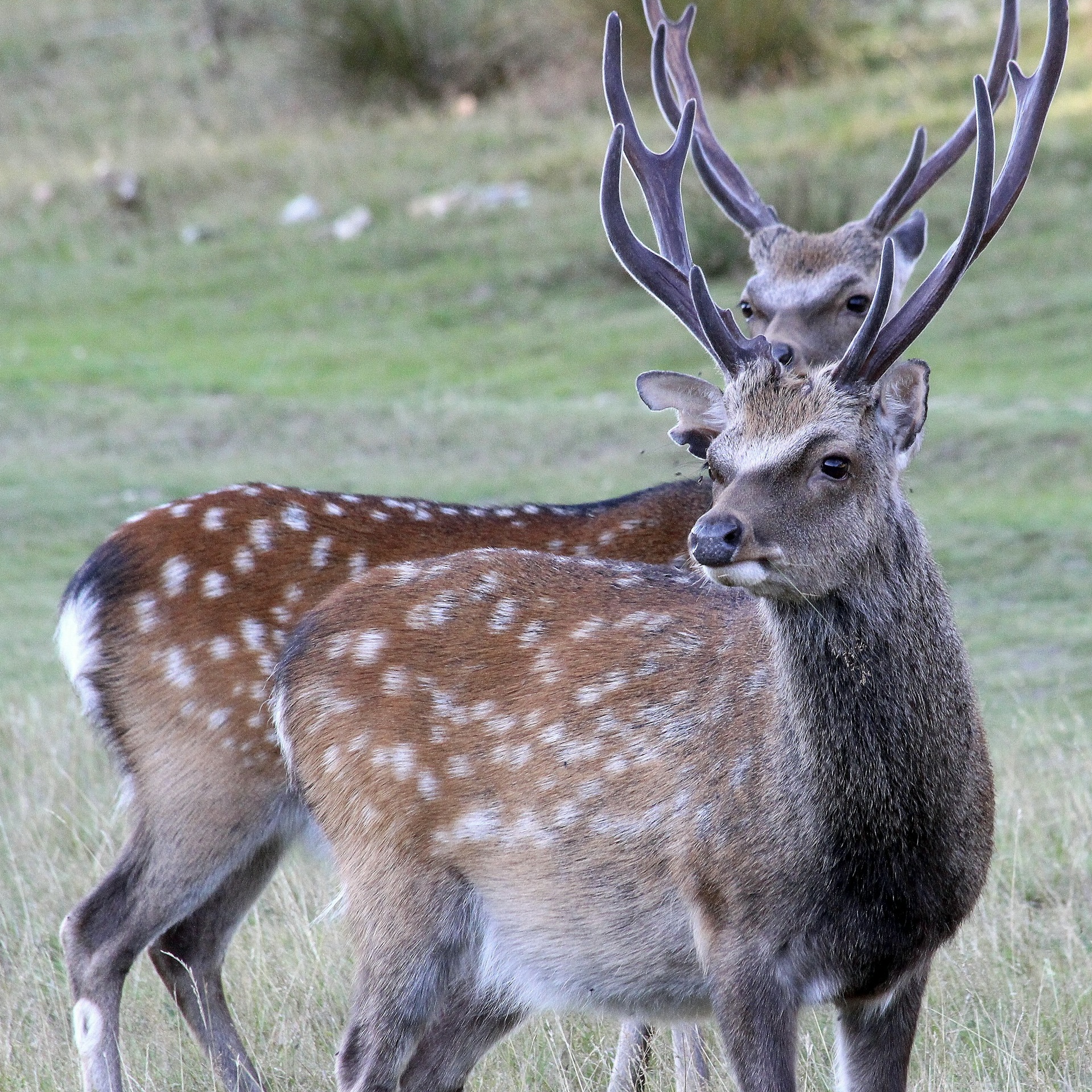
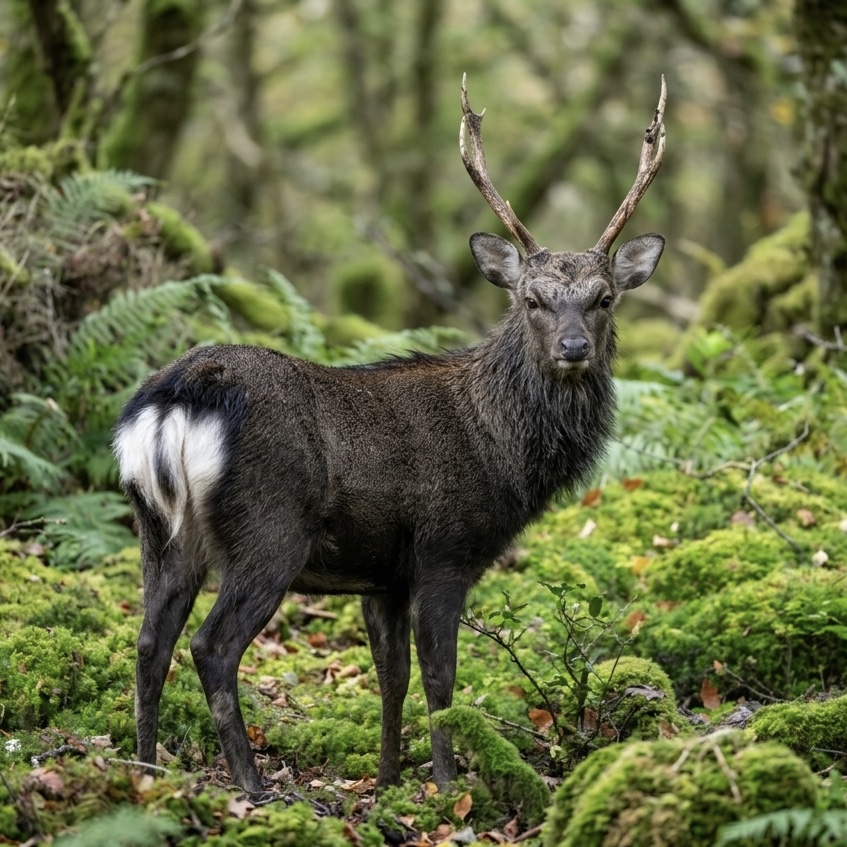
SIKA White rump flares dramatically when alarmed. Whistles. Darker in winter. Straight antler beam with cups.
⚠️ Hybrids exist — if uncertain, do not shoot.
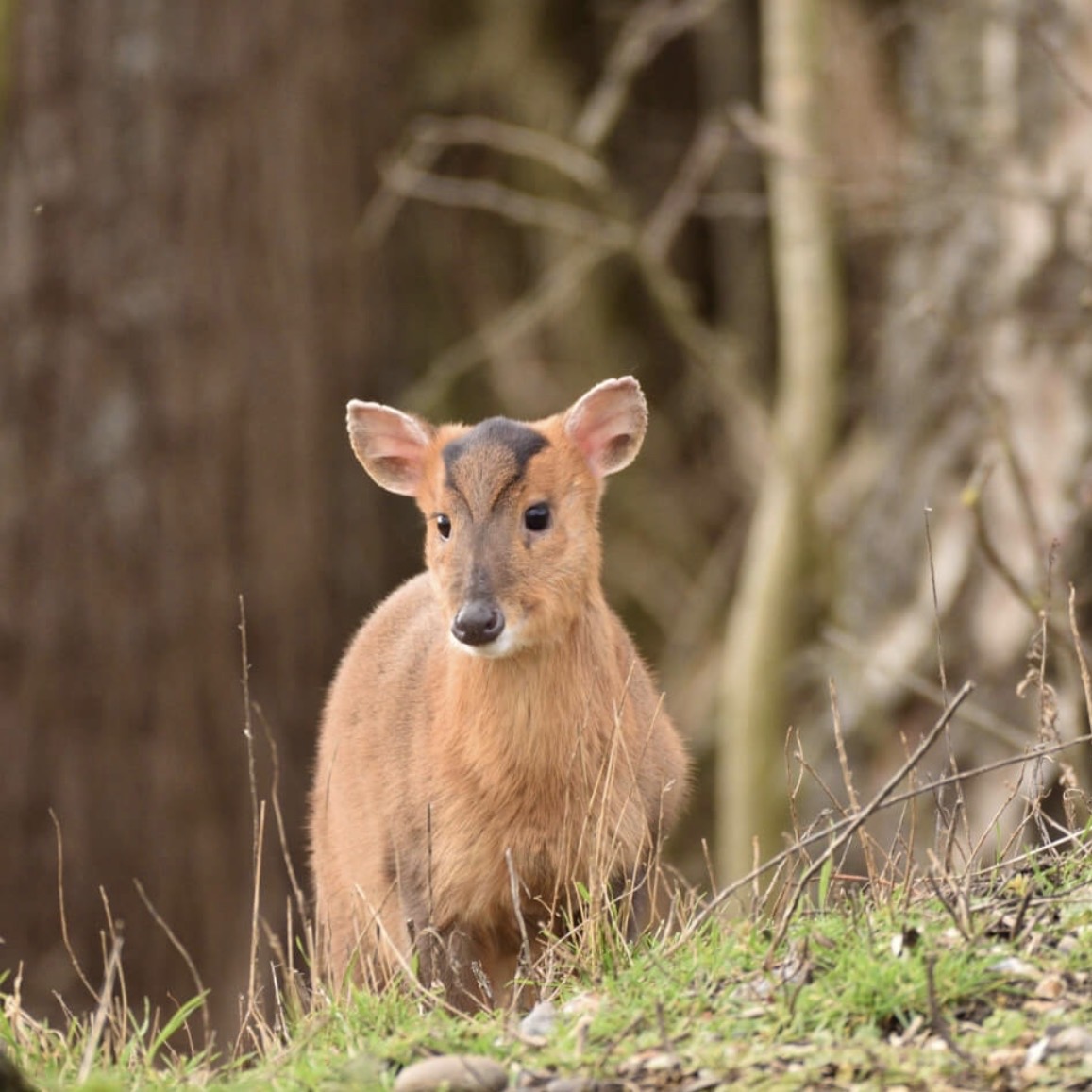
MUNTJAC Hunched, arched back. Reddish year-round. Dark V-lines on face. Bouncy gait.
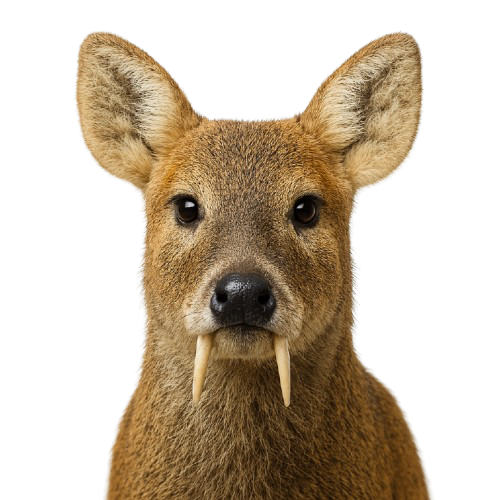
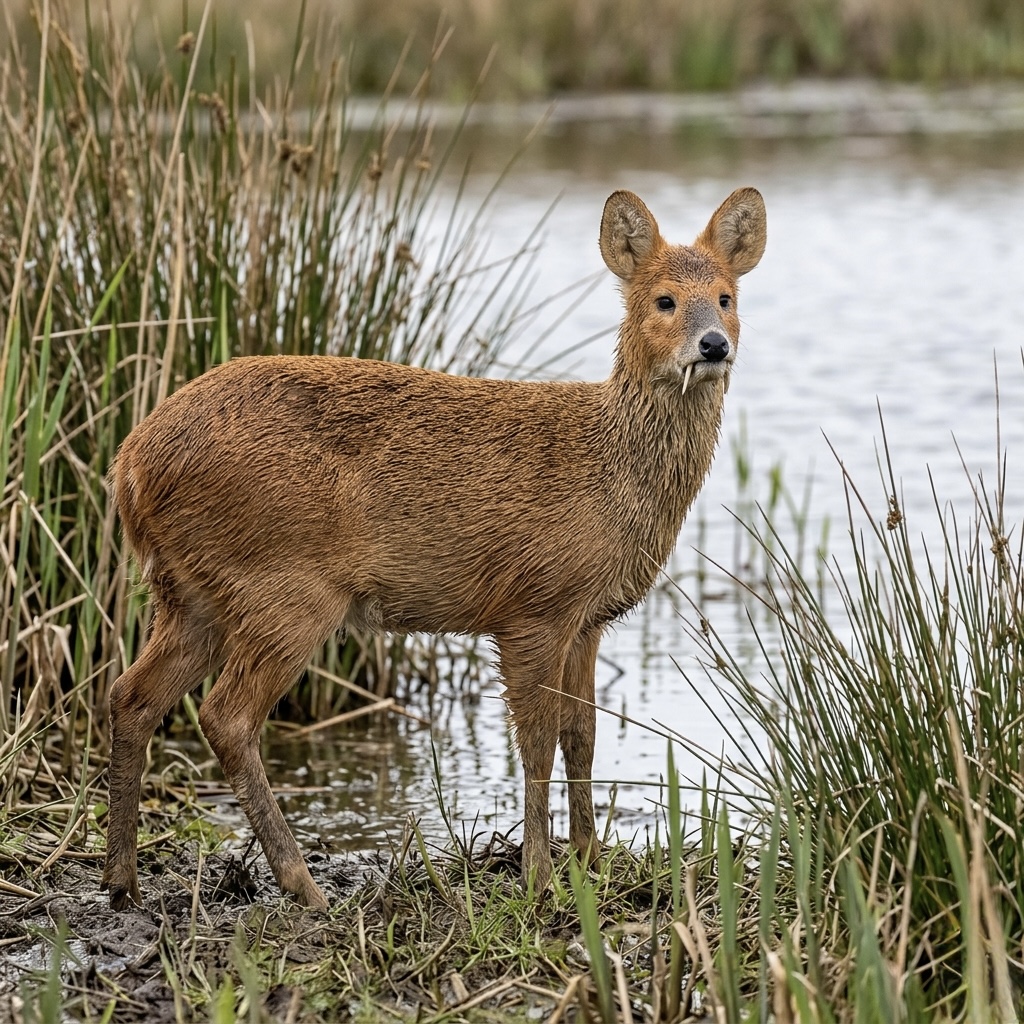
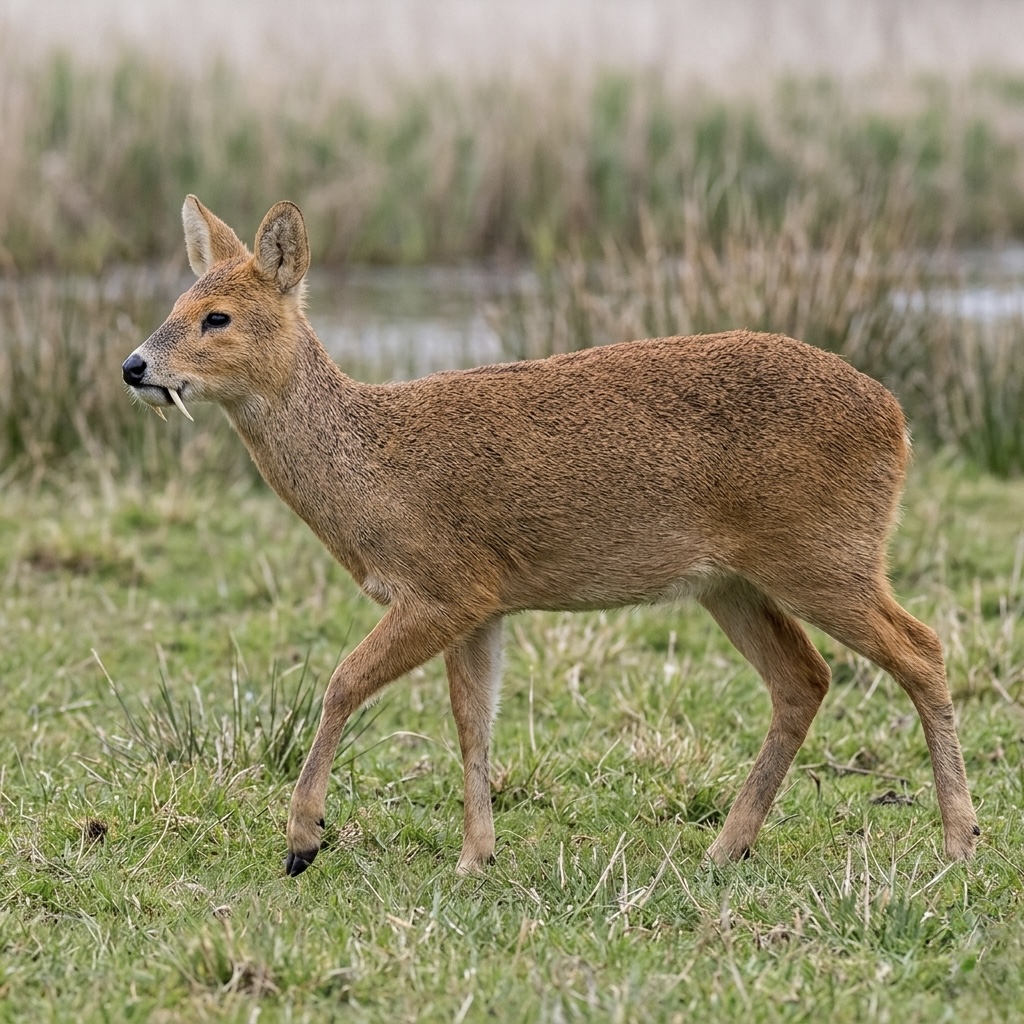
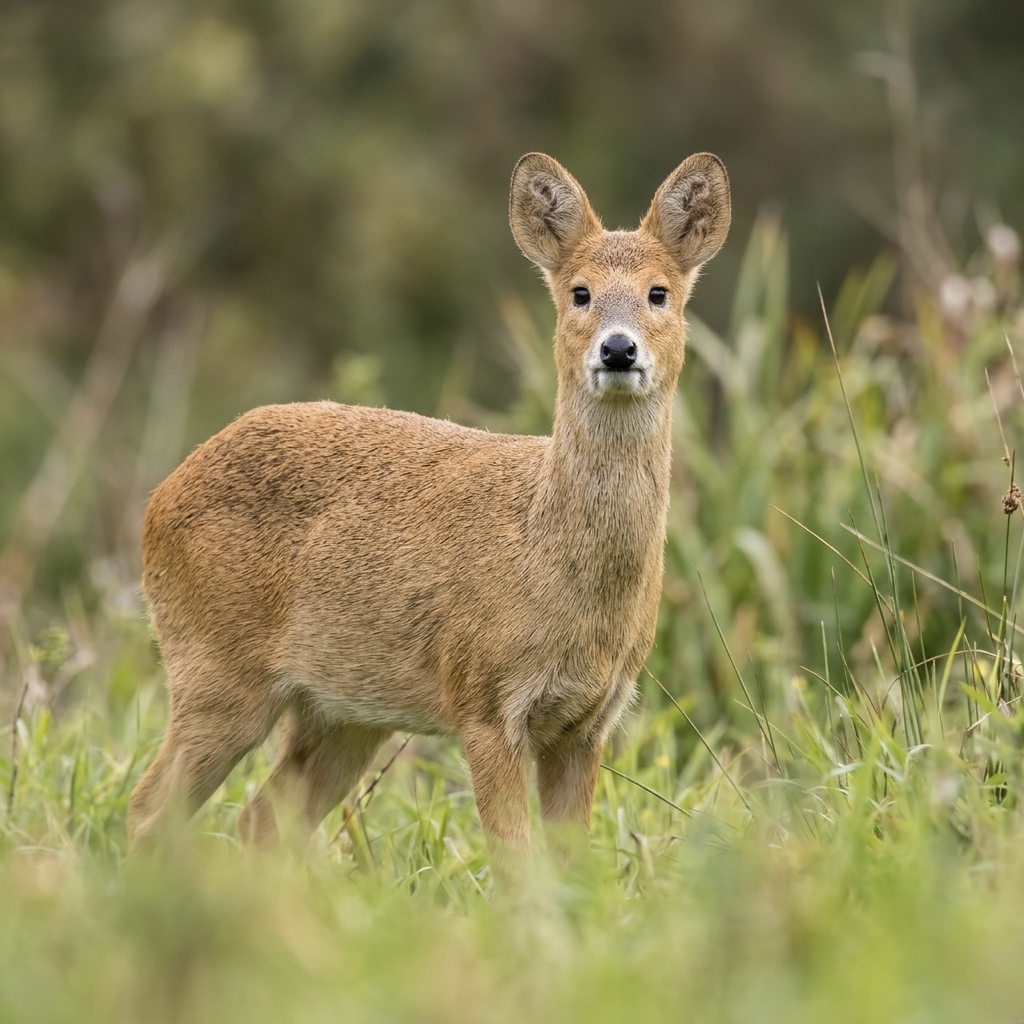
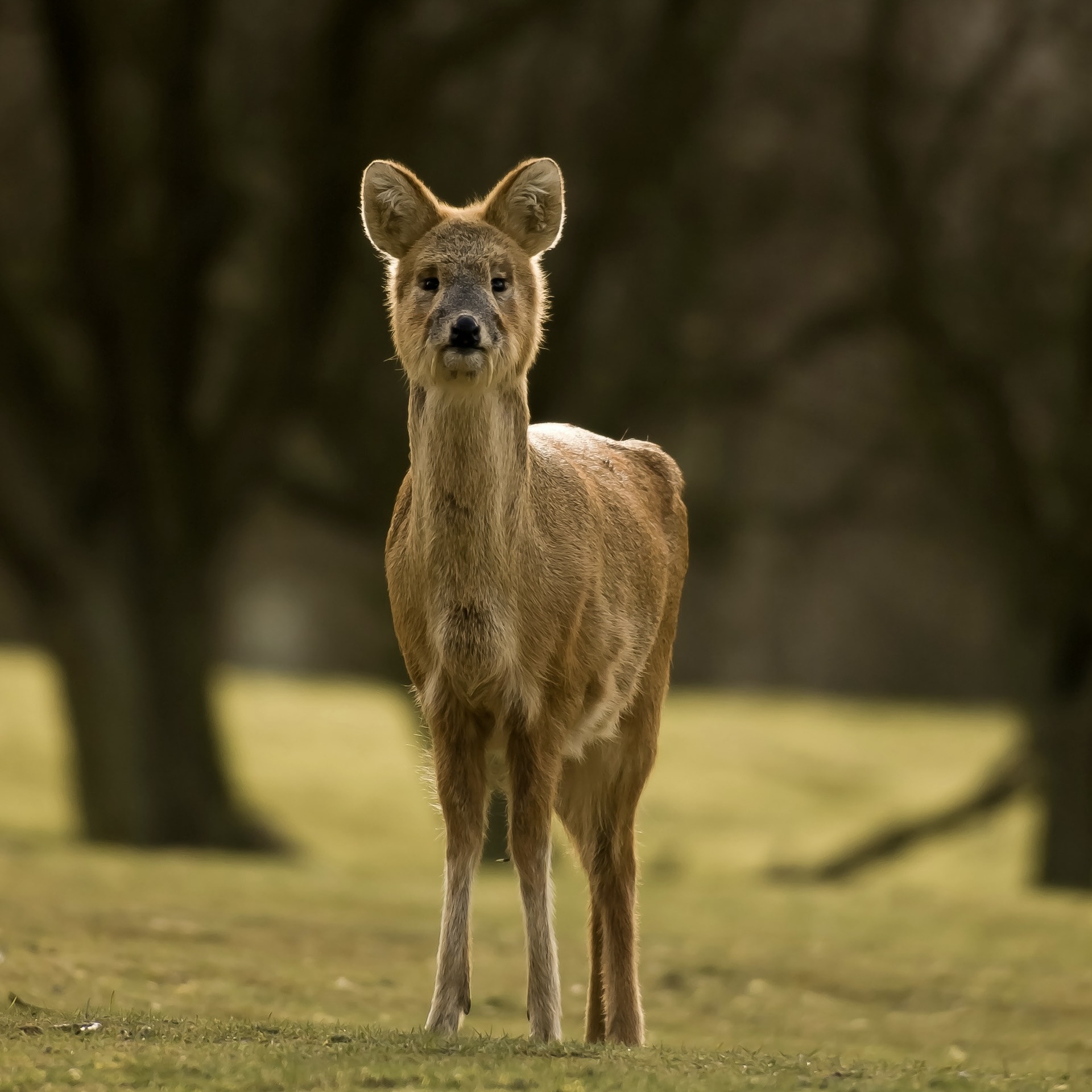
CWD Sandy coat. Enormous round ears. Smooth forehead — no antlers, no pedicles. Round soft face.
SIKA White rump patch. Shorter tail. More upright, stockier carriage.
⚠️ Humane, Ethical Dispatch
A clean, humane kill is the legal and moral obligation of every deer stalker. The objective is to induce unconsciousness as swiftly as possible, followed by death within seconds. A safe and humane shot is the key objective — meat damage and carcass value should not influence shot placement. Always wait for the correct angle and a clear, unobstructed view of the vital zone.
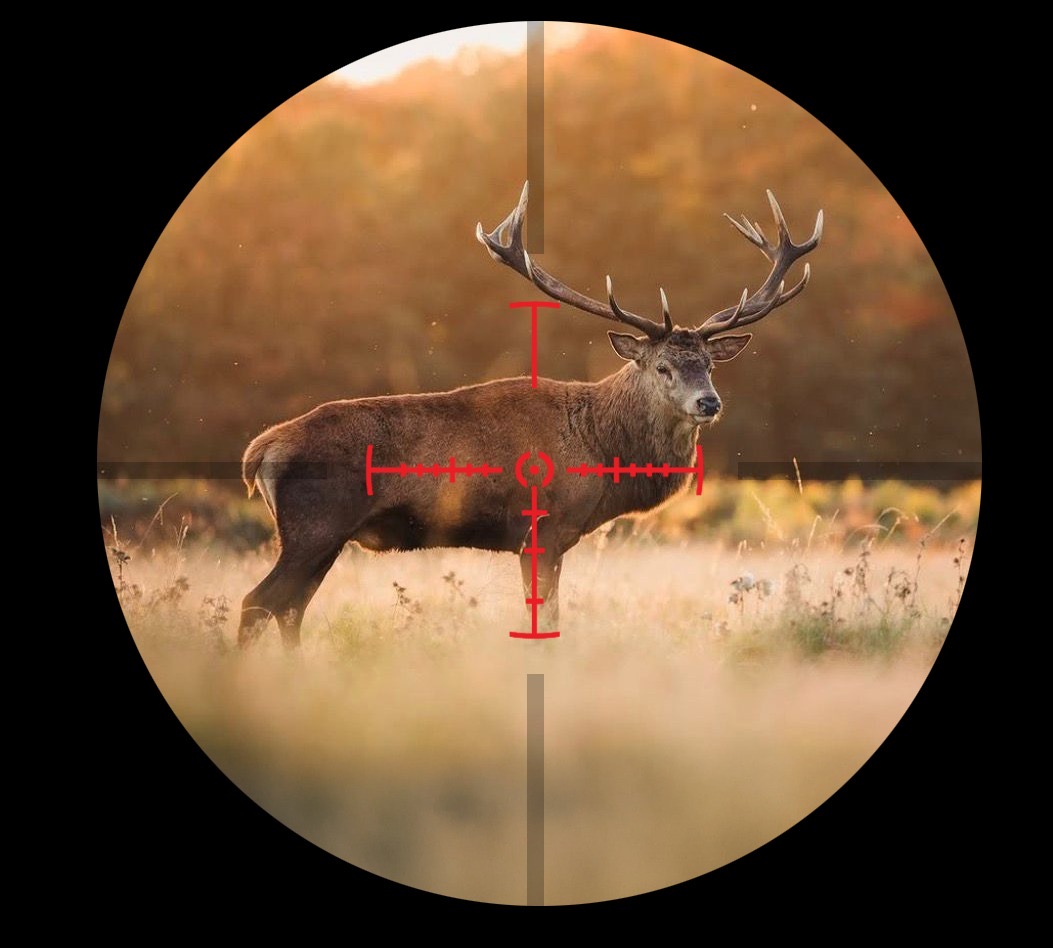
Broadside heart/lung aim point — halfway up the body, behind the foreleg.
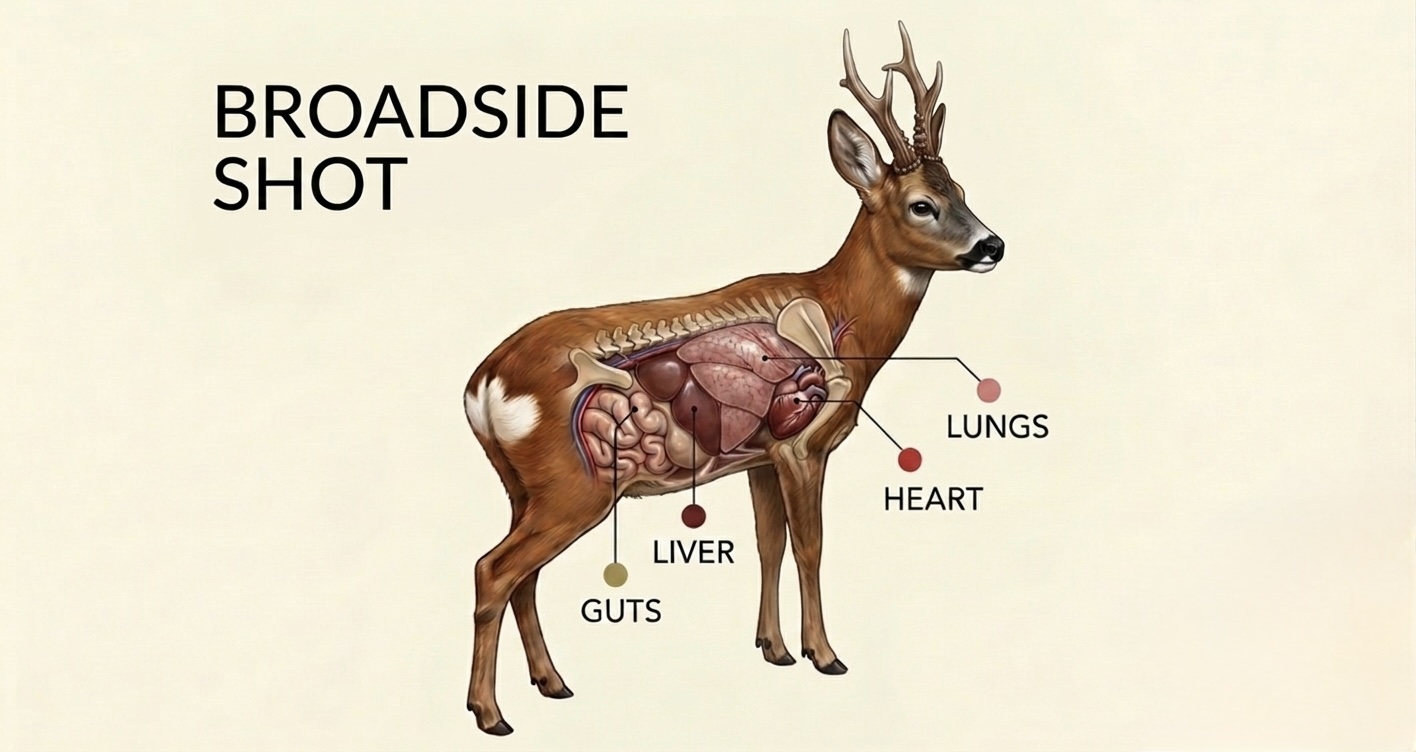
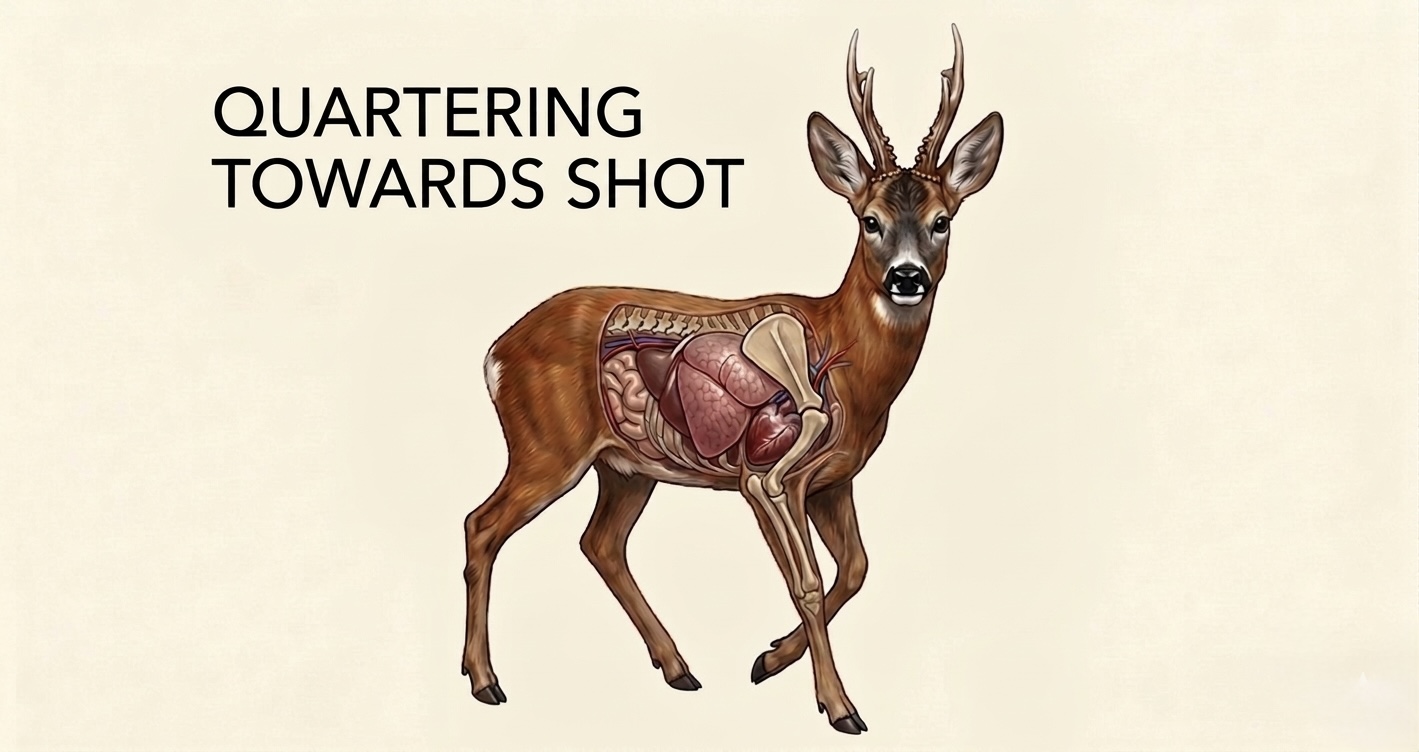
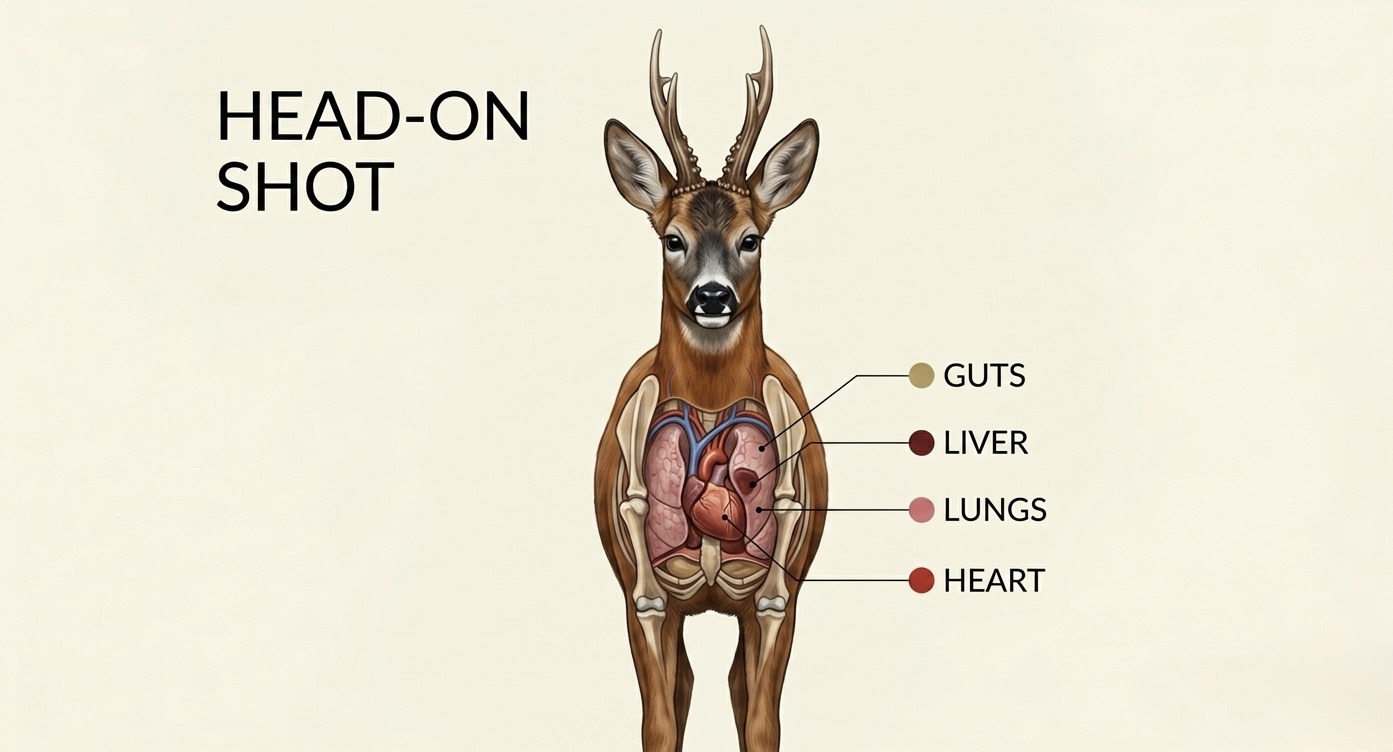
Vital Zone Anatomy
Know where the vital zones are before you raise the rifle.
Shot Angles & Which Vital Zone to Use
The angle of presentation determines both which vital zones are accessible and where to aim.
The anatomical plates below are roe buck (illustrative) — size and depth differ by species, but the relative position of heart, lung, liver, and paunch is broadly similar on UK deer.
Core Principles
Identify target and sex fully
Know what lies beyond
Use a rest or support
Follow up every shot
Call UKDTR if in doubt
Rush or force a shot
Prioritise carcass over safety
Shoot at a running deer
Ignore a suspected hit
Shoot beyond your range
Blood Sign
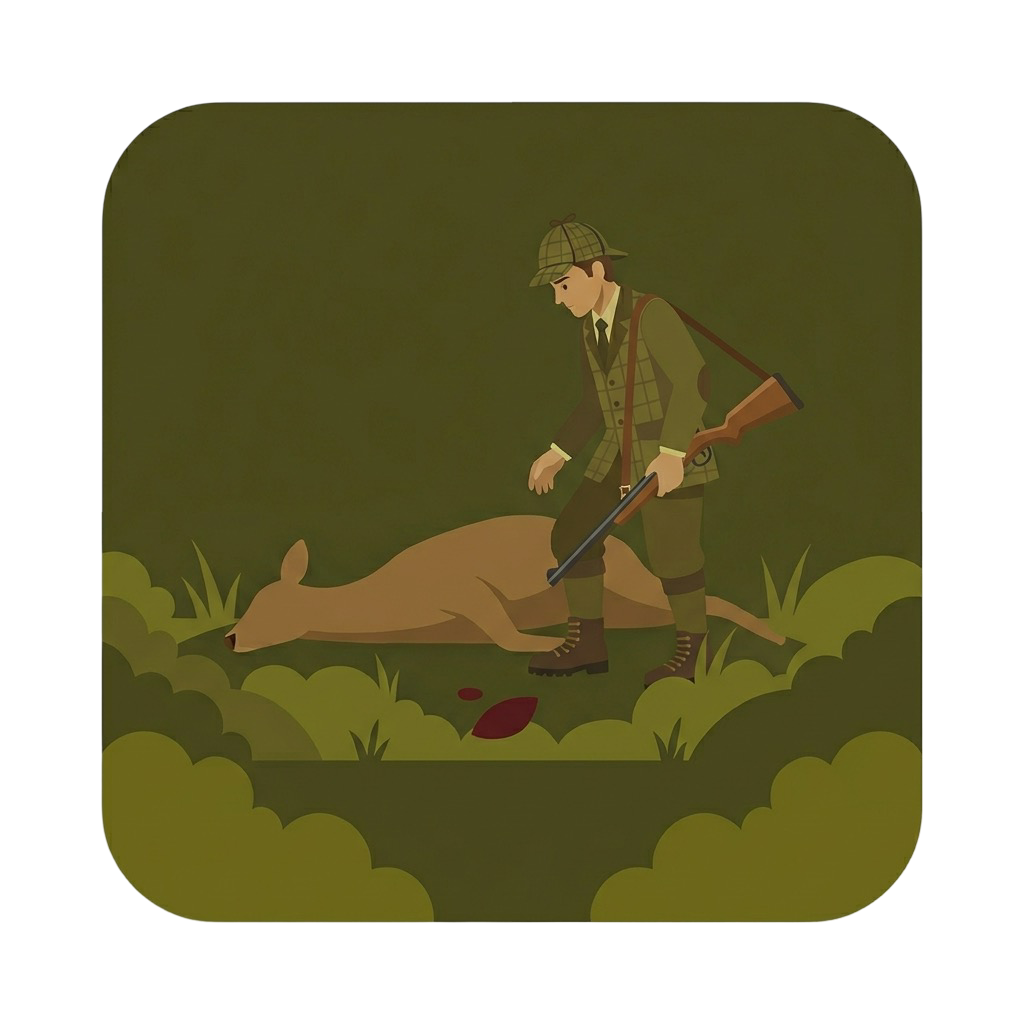
Mark the exact spot, wait 20–30 minutes before following up. Read the sign carefully:
A network of trained tracking dog teams who will come out to help locate and recover a wounded or lost deer. Volunteers only. No charge is ever made for their service.
🔪 Gralloch & Field Inspection
Must be carried out promptly to preserve carcass quality and fulfil your legal duty as a Large Game Trained Hunter.
Avoid contact between blood/organs and open cuts. Deer carry zoonotic pathogens including E. coli, Salmonella, and Lyme disease via ticks.
Carcass Inspection — Lymph Nodes
Mediastinal nodes — top of the lungs, close to the main blood vessels between the lungs.
Portal nodes — adjacent to the liver.
Note any signs of pleurisy (adhesions of lungs to chest wall) and discoloured or roughened areas inside the chest wall.
Lung tissue — should be pink-red and spongy. Look for lumps, abscesses, hardened areas or unusual discolouration — may indicate TB or parasite infection.
Mandibular nodes — base of tongue, below lower jaw. Cut along both outer edges of lower jaw and fold skin flaps outward to expose.
Retropharyngeal nodes — tan/grey, near midline where mouth meets back of throat. Only visible once head is removed — may require further cuts.
Check mouth, tongue and jaws for swellings, blisters or abscesses (possible Foot and Mouth).
Peel kidneys to check colour, size and texture. Look for micro-abscesses, adhesions or unusual discolouration.
Note: less severe bruising or contamination may be acceptable if affected areas are thoroughly cut back. Remove surface contamination by washing and/or cutting back — record if the carcass is submitted with visible traces.
For specific disease signs, action steps and contact numbers — see the Notifiable Diseases section in this Field Guide.
In the Field
Larder Hygiene
Venison Quality by Species
Timing and condition have a bigger impact on venison quality than species. Game dealers assess fat cover, smell and muscle tone — not just species. A well-gralloched yearling beats a trophy animal in rut every time.
Avoid: Post-rut stags (mid-Oct onwards) — tainted, depleted
Dealer notes: High demand, premium prices for quality carcasses
Avoid: Bucks from late Sep rut onwards — condition falls fast
Dealer notes: Pale, fine-grained, mild — premium paid year-round for does
Avoid: Bucks in Jul–Aug rut — condition drops quickly
Dealer notes: Small carcass but top price per kg; very high demand from restaurants
Avoid: Rutting stags (late Sep–Nov) — urine wallowing taints meat badly
Dealer notes: Unique intramuscular fat/marbling — some specialists rate it top UK venison
Avoid: Very old bucks with heavily worn tusks
Dealer notes: Growing demand; top restaurants pay premium; 8–10kg dressed ideal
Avoid: Bucks during Dec rut; very small carcasses under 8kg live weight
Dealer notes: Niche market but growing; check dealer acceptance before shooting
Most of what you find at the gralloch is not a notifiable disease — it is the everyday stuff, and the real question is simply: can I eat it, and do I bin the affected organ or the whole beast? This is a field reference for exactly that. Work down from what you can see.
Common — and the venison is fine
Widespread, harmless findings. Condemn only the part that is affected and take the deer home.
Do not eat — but not reportable
The carcass is not fit for the table, but these are not notifiable. Bin it responsibly; no need to call anyone.
Stop — these must be reported
Legally notifiable. You must report any suspicion to APHA — suspicion alone is enough, and failing to report is an offence. Do not let the carcass enter the food chain. Full signs, the law and the APHA numbers are in the Notifiable Diseases section below.
Certain diseases are legally notifiable — you must report any suspicion immediately to APHA. Failure to report is a criminal offence. Suspicion alone is sufficient and obligatory.
Who to Call
Not every deer is a trophy, and chasing medals should never drive a cull. But when a mature animal does come off the hill, it's worth knowing whether the head in the back of your vehicle is a notable beast by international standards — and how to measure it properly if you want it formally scored.
This section lets you take measurements from a cleaned, dried head and work out an indicative CIC score, so you can decide whether it's worth submitting for an official medal.
The CIC formula (Conseil International de la Chasse — the European standard, administered in the UK by the CIC UK Trophy Evaluation Board) uses measurements, weight (for some species), and subjective "beauty" points, with deductions for defects. Each species has its own formula and its own medal thresholds.
This is a guide for estimation only. An official CIC medal requires measurement by a CIC UKTEB-accredited judge. A home score within 3–5 points of a medal threshold is close enough that official measurement is worthwhile — subjective categories are easy to under-mark yourself on, and a measurer may find points you missed.
Thresholds and rules verified against CIC UK Trophy Evaluation Board (cicukteb.com), late 2024.
Before you measure
Prepare the head
- Minimum 30 days drying after preparation. CIC requires a drying-out period of at least 30 days from the time the head is cleaned. Don't measure a fresh head — it will weigh more (and then lose weight) as it dries.
- Clean the skull properly. Boiled or (better) cold-macerated. All flesh, brain, and membrane removed. Teeth left in. Lower jaw removed — keep separately for age estimation.
- Don't bleach the antlers. Only the skull bone. Antler colour is scored — bleaching strips points directly.
- Know your skull cut. CIC applies a weight deduction based on the cut (short-nose = no deduction; long nose or full skull = specific deductions, per species).
- For CWD: Tusks are removed from the upper jaw before evaluation. Don't submit the skull — just the tusks.
Tools
- Steel tape (1 m minimum). Fabric tape will stretch and cost you points.
- Flexible wire or lead string for following the curve of a beam. Lay the wire along the curve, mark start and end, then measure the wire on the steel tape.
- Vernier or dial callipers for circumferences where a tape won't sit cleanly.
- Digital scales — ±10 g for roe/muntjac/CWD; ±50 g for red/fallow.
- Graduated measuring jug + water for roe volume (displacement method).
- Flat level surface for span measurements.
Units and rounding
All CIC measurements use centimetres (cm) and grams (g) or kilograms (kg). Record to 1 mm / 1 g. Round the final score to two decimal places (the standard CIC presentation — e.g. "118.43 CIC points").
How to read the formula tables below
Each species section has:
- Measurement category — what you measure
- How to measure — the exact technique
- Formula — the coefficient applied to convert your measurement into points
- A worked example showing how the numbers stack up on a typical medal-class head
Red Deer(Cervus elaphus)
Two UK phenotypes with different thresholds:
- Scottish Red Deer (C. e. scoticus) — hill deer, lighter frames
- Red Deer (introduced) — English/lowland park-descended, heavier frames
Same formula for both; different medal thresholds.
Drying period: 30 days minimum.
Weight deduction by skull cut
Weigh the full prepared head, then subtract the deduction for your cut to get the CIC weight.
| Cut | Deduction |
|---|---|
| Full skull | – 0.70 kg |
| Long nose | – 0.50 kg |
| Short nose | Nil |
| Skull cap only | Nil |
Measurements — objective
| # | Category | How to measure | Formula |
|---|---|---|---|
| 1 | Length of antlers (avg) | Follow the outer curve of each main beam from lower edge of burr to tip of longest point using a wire. Average left and right, in cm. | Average × 0.5 |
| 2 | Length of brow tines (avg) | Burr to tip along upper side of tine, left and right, averaged, cm. | Average × 0.25 |
| 3 | Length of trez tines (avg) | Same technique, on the trez tine. If missing on a side, use 0 for that side. | Average × 0.25 |
| 4 | Burr circumference (L + R, summed) | Thickest point of each burr, measured around the outside. Add left and right. | Sum × 1.0 |
| 5 | Lower beam circumference (L + R, summed) | Thinnest point on each beam between the burr and brow tine. Add left and right. | Sum × 1.0 |
| 6 | Upper beam circumference (L + R, summed) | Thinnest point on each beam between the bey and trez tines. Add left and right. | Sum × 1.0 |
| 7 | Weight (after deduction) | CIC weight in kg (see deduction table above). | × 2.0 |
| 8 | Number of points | Count all tines ≥ 2.0 cm long on both antlers. Left + right. | Total × 1.0 |
Beauty points — subjective
| Category | Range | What earns top marks |
|---|---|---|
| Inner span | 0–3.0 | Score based on span as a % of avg beam length. 60–80% of beam length = 3.0; 50–60% or 80–90% = 2.0; outside = 1.0 or 0. |
| Colour of antlers | 0–2.0 | Dark chocolate brown throughout = 2.0. Mid-brown = 1.0. Pale yellow or bleached = 0. |
| Pearling | 0–2.0 | Heavy, rough, knobbly pearling covering both beams = 2.0. Smooth or worn = 0. |
| Tine quality (tips) | 0–2.0 | Sharp, polished, unbroken tine tips across all points = 2.0. Blunt, broken, split = 0. |
| Crown formation | 0–10.0 | Full cup crown of 3+ well-formed tines on both beams ("royal" 12-pt, "imperial" 14, "monarch" 16+) = 8–10. Cup on one side only = 4–6. Forked crown with 2 good tines both sides = 3–5. No crown = 0. Biggest single driver for red. |
Penalties
Total deduction up to 3.0 points for: broken tines, severely asymmetric beams, abnormal growths, stunted development.
The formula
Red Deer CIC score =
  (avg beam length × 0.5)
  + (avg brow tine length × 0.25)
  + (avg trez tine length × 0.25)
  + (sum of burr circumferences × 1.0)
  + (sum of lower beam circumferences × 1.0)
  + (sum of upper beam circumferences × 1.0)
  + (weight in kg × 2.0)
  + (point count × 1.0)
  + span points (0–3.0)
  + colour points (0–2.0)
  + pearling points (0–2.0)
  + tine quality points (0–2.0)
  + crown points (0–10.0)
  − penalties (0–3.0)
Medal thresholds
| Phenotype | Bronze | Silver | Gold |
|---|---|---|---|
| Scottish Red Deer | 130 | 145 | 160 |
| Red Deer (introduced / English & lowland) | 170 | 190 | 210 |
Worked example — English/lowland red stag (14-pointer, mature)
| Measurement | Value | Coefficient | Points |
|---|---|---|---|
| Avg beam length | 95.0 cm | × 0.5 | 47.5 |
| Avg brow tine | 30.0 cm | × 0.25 | 7.5 |
| Avg trez tine | 24.0 cm | × 0.25 | 6.0 |
| Sum burr circumferences | 26.0 cm | × 1.0 | 26.0 |
| Sum lower beam circumferences | 24.0 cm | × 1.0 | 24.0 |
| Sum upper beam circumferences | 22.0 cm | × 1.0 | 22.0 |
| Weight (short-nose, no deduction) | 7.5 kg | × 2.0 | 15.0 |
| Point count (14) | 14 | × 1.0 | 14.0 |
| Inner span (75 cm = 79% of beam) | — | — | 3.0 |
| Colour (dark brown) | — | — | 1.5 |
| Pearling (good) | — | — | 1.5 |
| Tine quality (sharp, unbroken) | — | — | 1.5 |
| Crown (full cup both sides, 14-pt) | — | — | 8.0 |
| Penalties (none) | — | — | 0 |
| Total | 177.5 |
Score: 177.5 — just into bronze for introduced/English red (bronze 170). A genuine monarch of 16+ points with heavier weight and fuller pearling would push 200+ (silver/gold).
Roe Deer(Capreolus capreolus)
The most commonly scored UK trophy. Dominated by weight and volume — not length.
Drying period: 30 days minimum.
Weight deduction by skull cut
| Cut | Deduction |
|---|---|
| Full skull | – 90 g |
| Long nose | – 65 g |
| Short nose | Nil |
| Skull cap only | Nil |
Measurements — objective
| # | Category | How to measure | Formula |
|---|---|---|---|
| 1 | Length of antlers (avg) | Follow the curve from burr to tip of main beam on each side, using a wire. Average in cm. | Average × 0.5 |
| 2 | Weight (after deduction) | CIC weight in grams (not kg). | × 0.1 |
| 3 | Volume (water displacement) | Fill a measuring jug to a marked line. Submerge both antlers (not skull — mask the burrs with tape or hold at burr line). Measure displacement in cm³. Alternative: submerge in a container filled to brim and measure overflow. | × 0.3 |
Beauty points — subjective
| Category | Range | What earns top marks |
|---|---|---|
| Inner span | 0–4.0 | Span as % of avg beam length. 30–75% = 4.0 (ideal); 20–30% or 75–85% = 2–3; outside = 0–1. |
| Colour | 0–4.0 | Dark brown or near-black = 4.0. Mid-brown = 2–3. Pale yellow or bleached = 0–1. |
| Pearling | 0–4.0 | Heavy, prominent, rough pearling covering full length of both beams = 4.0. Smooth = 0. |
| Coronets (burrs) | 0–4.0 | Thick, deep, well-developed, heavily ornamented burrs = 4.0. Thin or smooth = 0. |
| Tine quality / regularity | 0–5.0 | Six sharp, well-formed, unbroken tines with symmetrical matching beams = 5.0. Asymmetric or broken = 0. |
Penalties
Up to 5.0 points for: severe asymmetry, broken tines, pale rubbing damage, abnormal growths, defective coronets.
The formula
Roe Deer CIC score =
  (avg beam length × 0.5)
  + (weight in g × 0.1)
  + (volume in cm³ × 0.3)
  + span points (0–4.0)
  + colour points (0–4.0)
  + pearling points (0–4.0)
  + coronet points (0–4.0)
  + tine quality / regularity points (0–5.0)
  − penalties (0–5.0)
Medal thresholds
| Phenotype | Bronze | Silver | Gold |
|---|---|---|---|
| European Roe Deer (UK) | 105 | 115 | 130 |
Worked example — gold-medal UK roe buck
| Measurement | Value | Coefficient | Points |
|---|---|---|---|
| Avg beam length | 24.0 cm | × 0.5 | 12.0 |
| Weight (short-nose, no deduction) | 570 g | × 0.1 | 57.0 |
| Volume | 200 cm³ | × 0.3 | 60.0 |
| Span (12 cm = 50% of beam) | — | — | 4.0 |
| Colour (dark brown) | — | — | 3.0 |
| Pearling (heavy, full length) | — | — | 4.0 |
| Coronets (thick, deep) | — | — | 3.5 |
| Tine quality / regularity (6 sharp, symmetric) | — | — | 4.5 |
| Penalties | — | — | 0 |
| Total | 148.0 |
Score: 148.0 — gold (gold threshold 130).
Worked example — bronze-medal UK roe buck
| Measurement | Value | Coefficient | Points |
|---|---|---|---|
| Avg beam length | 23.0 cm | × 0.5 | 11.5 |
| Weight (short-nose) | 460 g | × 0.1 | 46.0 |
| Volume | 150 cm³ | × 0.3 | 45.0 |
| Span (11 cm = 48% of beam) | — | — | 3.5 |
| Colour (mid-brown) | — | — | 2.0 |
| Pearling (moderate) | — | — | 2.5 |
| Coronets (average) | — | — | 2.0 |
| Tine quality / regularity (6 pts, some asymmetry) | — | — | 3.0 |
| Penalties | — | — | 0 |
| Total | 105.5 |
Score: 105.5 — just into bronze (bronze threshold 105).
Take-away on roe
Weight and volume together contribute 80–120 of a medal score. Beam length is a smaller factor than most stalkers assume — a head with 25 cm beams but only 400 g of weight will not medal. Pick up the head. If it feels heavy for its size, measure it properly.
Exclusions
Perruque bucks (permanent velvet mass from hormonal abnormality) are excluded — volume can't be measured accurately.
Fallow Deer(Dama dama)
Fallow scoring is dominated by palm quality.
Drying period: 30 days minimum.
Weight deduction by skull cut
| Cut | Deduction |
|---|---|
| Full skull | – 0.25 kg |
| Long nose | – 0.10 kg |
| Short nose | Nil |
| Skull cap only | Nil |
Measurements — objective
| # | Category | How to measure | Formula |
|---|---|---|---|
| 1 | Length of antlers (avg) | Follow outer curve of each beam from burr to end of longest palm tine, with wire. Averaged in cm. | Average × 0.5 |
| 2 | Length of brow tines (avg) | Burr to tip along upper side, averaged, cm. | Average × 0.25 |
| 3 | Length of trez tines (avg) | Same technique, cm. | Average × 0.25 |
| 4 | Length of palms (avg) | From where the beam begins to flatten into the palm, to end of longest palm tine. Averaged, cm. | Average × 1.0 |
| 5 | Width of palms (avg) | Widest perpendicular width across palm, with straight calliper-style tape. Averaged, cm. | Average × 1.5 |
| 6 | Beam circumference (L + R, summed) | Thinnest point between brow tine and palm on each side. Add left and right. | Sum × 1.0 |
| 7 | Weight (after deduction) | CIC weight in kg. | × 2.0 |
Beauty points — subjective
| Category | Range | What earns top marks |
|---|---|---|
| Inner span | 0–3.0 | Span as % of avg beam length. 55–75% = 3.0; outside = lower. |
| Colour | 0–2.0 | Dark brown palms and beams = 2.0. Pale or bleached = 0. |
| Palm tines / palm quality | 0–10.0 | Wide (14+ cm) and long (30+ cm) palms with smooth continuous edges and 5+ palm tines each side = 9–10. Narrow or notched palms = 0–3. Biggest driver for fallow. |
| Regularity | 0–3.0 | Both palms identical in size, shape, tine count = 3.0. Clearly asymmetric = 0. |
Penalties
Up to 3.0 points for: severe notching, narrow palms, broken palm tines, asymmetry.
The formula
Fallow Deer CIC score =
  (avg beam length × 0.5)
  + (avg brow tine length × 0.25)
  + (avg trez tine length × 0.25)
  + (avg palm length × 1.0)
  + (avg palm width × 1.5)
  + (sum beam circumferences × 1.0)
  + (weight in kg × 2.0)
  + span points (0–3.0)
  + colour points (0–2.0)
  + palm tines / quality (0–10.0)
  + regularity (0–3.0)
  − penalties (0–3.0)
Medal thresholds
| Phenotype | Bronze | Silver | Gold |
|---|---|---|---|
| Fallow Deer | 160 | 170 | 180 |
Worked example — bronze-silver fallow buck
| Measurement | Value | Coefficient | Points |
|---|---|---|---|
| Avg beam length | 62.0 cm | × 0.5 | 31.0 |
| Avg brow tine | 16.0 cm | × 0.25 | 4.0 |
| Avg trez tine | 14.0 cm | × 0.25 | 3.5 |
| Avg palm length | 32.0 cm | × 1.0 | 32.0 |
| Avg palm width | 15.0 cm | × 1.5 | 22.5 |
| Sum beam circumferences | 24.0 cm | × 1.0 | 24.0 |
| Weight (short-nose) | 3.0 kg | × 2.0 | 6.0 |
| Span (48 cm = 77% of beam) | — | — | 3.0 |
| Colour (dark) | — | — | 1.5 |
| Palm quality (wide, 5 tines/side, smooth) | — | — | 8.0 |
| Regularity (good) | — | — | 2.5 |
| Penalties | — | — | 0 |
| Total | 168.0 |
Score: 168.0 — bronze (bronze 160, silver 170). A head with 14 cm palms drops below bronze; 17 cm palms with 5+ tines per side tips into silver/gold.
Exclusions (atypical)
A fallow trophy with both brow tines missing, or with a brow AND a trez tine missing, is excluded as atypical. Broken tines are not disqualifying — only tines that never formed.
Sika Deer(Cervus nippon)
No weight element in the sika formula. UK sika are Japanese sika (Cervus nippon nippon).
Drying period: 30 days minimum.
Measurements — objective
| # | Category | How to measure | Formula |
|---|---|---|---|
| 1 | Length of antlers (avg) | Follow outer curve of each beam from burr to tip, averaged in cm. | Average × 0.5 |
| 2 | Length of brow tines (avg) | Burr to tip, averaged. | Average × 0.25 |
| 3 | Length of 2nd tines (avg) | Base to tip, averaged. | Average × 0.25 |
| 4 | Length of 3rd (inner) tines (avg) | At top of beam, base to tip, averaged. Short inner tines are normal on sika. | Average × 0.5 |
| 5 | Burr circumference (L + R, summed) | Add left and right, cm. | Sum × 1.0 |
| 6 | Lower beam circumference (L + R, summed) | Thinnest point between burr and brow on each side, added. | Sum × 1.0 |
| 7 | Upper beam circumference (L + R, summed) | Thinnest point between 2nd and 3rd tines on each side, added. | Sum × 1.0 |
Beauty points — subjective
| Category | Range | What earns top marks |
|---|---|---|
| Inner span | 0–3.0 | Span as % of beam length, 70–85% = 3.0; outside = lower. Sika normally have good span. |
| Colour | 0–2.0 | Dark brown with pale tine tips = 2.0. Uniform pale = 0. |
| Pearling | 0–2.0 | Rough, defined pearling = 2.0. Smooth = 0. |
| Tine formation | 0–3.0 | Standard 8-point head (4+4) with well-formed, sharp tines = 3.0. Reduced tine count = 0–2. |
| Regularity | 0–3.0 | Both beams matching = 3.0. Asymmetric = 0. |
Penalties
Up to 3.0 points for: asymmetry, broken tines, abnormal growths.
The formula
Sika Deer CIC score =
  (avg beam length × 0.5)
  + (avg brow tine length × 0.25)
  + (avg 2nd tine length × 0.25)
  + (avg 3rd/inner tine length × 0.5)
  + (sum burr circumferences × 1.0)
  + (sum lower beam circumferences × 1.0)
  + (sum upper beam circumferences × 1.0)
  + span points (0–3.0)
  + colour points (0–2.0)
  + pearling points (0–2.0)
  + tine formation points (0–3.0)
  + regularity points (0–3.0)
  − penalties (0–3.0)
Note: no weight element. Do not weigh the head.
Medal thresholds
UK sika are Japanese sika. Only pure Japanese sika are scored — hybrids with red deer are explicitly excluded by CIC.
| Phenotype | Bronze | Silver | Gold |
|---|---|---|---|
| Japanese Sika Deer (UK) | 225 | 240 | 255 |
Note on sika scoring
The simplified formula above gives the measurement framework, but CIC sika scoring in practice applies additional cumulative circumference points at multiple locations along each beam. A mature UK Japanese sika stag reaching 225 CIC typically has main beams of 50+ cm, an inside span of 40+ cm, and full 8-point formation with strong burrs. If a head clearly hits these physical markers, submit it to a CIC UKTEB measurer — the exact coefficients above will give an approximate indicative score, but sika is the species where DIY scoring is least reliable against the published threshold. Treat the 225 bronze as the authoritative target and measure the head for real.
⚠️ Hybrid warning
CIC will not medal known or suspected sika × red hybrids. If you stalk a hybrid zone (parts of Scotland particularly), consult an accredited measurer before submission — intermediate features disqualify the head.
Muntjac(Muntiacus reevesi)
No weight element. Tusks are not scored — they're not part of the CIC muntjac formula.
Drying period: 30 days minimum.
Measurements — objective
| # | Category | How to measure | Formula |
|---|---|---|---|
| 1 | Length of antlers (avg) | Burr to tip along the outer curve, averaged in cm. | Average × 1.0 |
| 2 | Length of brow tines (avg) | Base to tip on each side, averaged. If absent, use 0. | Average × 0.5 |
| 3 | Burr circumference (L + R, summed) | Add left and right, cm. | Sum × 1.0 |
| 4 | Length of pedicles (avg) | Base of pedicle (skull) to underside of burr, averaged. Unique to muntjac — long pedicles count. | Average × 0.5 |
| 5 | Inner span | Widest inside distance between beams, cm. | × 1.0 |
Beauty points — subjective
| Category | Range | What earns top marks |
|---|---|---|
| Colour | 0–2.0 | Dark brown throughout = 2.0. Pale = 0. |
| Pearling | 0–2.0 | Well-defined pearling on burrs and lower beam = 2.0. Smooth = 0. |
| Regularity | 0–2.0 | Matching beams and brow tines both sides = 2.0. Asymmetric = 0. |
Penalties
Up to 2.0 points for: broken tips, asymmetry, fused or atypical formations.
The formula
Muntjac CIC score =
  (avg beam length × 1.0)
  + (avg brow tine length × 0.5)
  + (sum burr circumferences × 1.0)
  + (avg pedicle length × 0.5)
  + (inner span × 1.0)
  + colour points (0–2.0)
  + pearling points (0–2.0)
  + regularity points (0–2.0)
  − penalties (0–2.0)
Medal thresholds
| Phenotype | Bronze | Silver | Gold |
|---|---|---|---|
| Reeves' Muntjac (UK) | 56 | 60 | 64 |
Worked example — bronze-silver muntjac buck
| Measurement | Value | Coefficient | Points |
|---|---|---|---|
| Avg beam length | 13.5 cm | × 1.0 | 13.5 |
| Avg brow tine | 2.5 cm | × 0.5 | 1.25 |
| Sum burr circumferences | 15.0 cm | × 1.0 | 15.0 |
| Avg pedicle length | 10.0 cm | × 0.5 | 5.0 |
| Inner span | 12.0 cm | × 1.0 | 12.0 |
| Colour (dark) | — | — | 1.5 |
| Pearling (good) | — | — | 1.5 |
| Regularity (symmetric) | — | — | 1.5 |
| Penalties | — | — | 0 |
| Total | 51.25 |
Score: 51.25 — just below bronze (bronze 56). Increase beam length to 14.5 cm, or increase any of burr circumference, pedicle length or inner span, and this head crosses bronze. A mature Reeves' muntjac with 14+ cm beams, thick burrs and good pearling is a typical medal specimen.
Exclusions (atypical)
Trophies with extra brow tines or fused/shared main beams are excluded. Missing brow tines or broken beams are NOT disqualifying.
Chinese Water Deer(Hydropotes inermis)
Formula comprehensively revised in 2023. Antlerless deer — the trophy is the pair of upper canine tusks.
Drying period: 30 days minimum.
Eligibility — maturity stages
Before measuring, check tusk root condition:
| Stage | Root condition | Eligibility |
|---|---|---|
| Juvenile | Fully open root (hollow, straight-edged, thin walls) | NOT eligible |
| Adult | Root partly closed; rounding but may still show cavity | Eligible |
| Mature | Root fully closed over, no visible cavity | Eligible + scores maturity points |
Tusks must be removed from the upper jaw before measurement.
Measurements — objective
| # | Category | How to measure | Formula |
|---|---|---|---|
| 1 | Length of tusks (L + R, summed) | Along outer curve from gum line to tip of each tusk, sum both, cm. | Sum × 5.0 |
| 2 | Circumference of tusks (L + R, summed) | At widest point of each tusk, sum both, cm. | Sum × 5.0 |
Maturity additions — post-2023 additions
These reward genuinely mature bucks and are the key change that eliminated the previous glut of juvenile golds.
| Addition | Points |
|---|---|
| Thickening / calcification of tusk root (significant bony deposit) | 0–30 |
| Visible presence of the incisal nerve (visible on both tusks when held up to light) | 0–30 |
| Both tusk roots fully closed (mature stage on both) | 0–20 |
The formula
CWD CIC score =
  (sum of tusk lengths × 5.0)
  + (sum of tusk circumferences × 5.0)
  + root thickening points (0–30)
  + incisal nerve presence points (0–30)
  + both roots fully closed points (0–20)
No deductions for left/right asymmetry under the 2023 system (this was explicitly removed).
Medal thresholds
| Phenotype | Bronze | Silver | Gold |
|---|---|---|---|
| Chinese Water Deer (UK) | 220 | 250 | 280 |
Note on CWD scoring
The 2023 formula is recent and the exact weighting of the maturity additions is not fully published in public references. The thresholds (220/250/280) reflect the recalibrated scoring that eliminated juvenile golds. The coefficients above are the standard published multipliers; the maturity addition ranges are taken from the CIC UKTEB public announcement of the 2023 revision. Expect a real silver-medal head to carry tusks of 7.5 cm+, circumferences of 4.5 cm+, with fully closed mature root structures and both incisal nerves visible. For CWD more than any other species, submit to a CIC UKTEB measurer for reliable scoring — the 2023 formula is new enough that self-scoring against published fragments is approximate.
Practical check — do the tusks look mature?
Before measuring at all: hold the tusks up to light. If you can see a dark line running down the centre (the incisal nerve), it's a mature animal. If the root hole is fully closed over at the base, it's mature. If the root is open and hollow, stop — it can't be evaluated, regardless of length.
What to do next
Within 5 points of a threshold
Submit it for official measurement. Subjective categories (colour, pearling, symmetry, crown) are easy to under-mark yourself on; an accredited measurer may find points. Near-threshold is where official scoring matters most.
Clearly above a threshold
Submit it. Medal certificates carry international recognition. The head joins the UK CIC trophy record — useful scientific data for deer management research and a record for your own diary.
Clearly below
Log the score in your Cull Diary anyway. Year-on-year trophy quality trends tell you about herd management, age structure, and habitat.
Getting an official measurement
CIC UKTEB (cicukteb.com) — the only authorised body in the UK.
Where heads can be measured:
- Major shows and game fairs — CIC UKTEB attend Moy Country Fair, Highclere Show, Yorkshire Shooting Show, Northern Shooting Show, and others. Stands hosted by BDS, BASC, SGA or NGO.
- Private appointments with accredited measurers — listings on cicukteb.com.
- SGA member discount at Moy — first trophy free, subsequent discounted.
Fees typically £10–25 per head. Heads exceeding threshold receive a medal certificate and enter the UK trophy record.
Fair chase only. CIC will only evaluate heads from free-living populations. Park and farmed animals are excluded. You'll be asked to sign a declaration of fair chase.
⚠️ Ethics
Good management produces trophy animals as a by-product — allowing prime stags and bucks to reach maturity within a proper cull plan gives rise to heads that score well. But the cull plan drives selection, not the score.
- Don't pass on a welfare cull (injured, old, abnormal) hoping for a better head next season.
- Don't leave a mature animal out of plan season to grow a bigger trophy.
- Sika hybrids can't be medal'd — in hybrid zones, ID matters more than potential score.
- A bronze taken from a planned cull is a better head than a gold taken out of plan.
All thresholds, drying periods, weight deductions, and eligibility rules verified against the CIC UK Trophy Evaluation Board (cicukteb.com) as of October 2024. Scoring coefficients and beauty-point ranges based on standard published CIC methodology used in UK accredited-measurer training. CIC formulas are revised periodically — the CWD formula was comprehensively overhauled in 2023. For any official submission, refer to the current CIC UKTEB published criteria.
When Each Species Ruts
Rut Signs to Read
Deer Welfare Principles
Under the Wild Mammals (Protection) Act 1996 and the Deer Acts, unnecessary suffering is prohibited. Deer welfare considerations apply before, during and after the shot.
Qualifications overview — DMQ & BDS
The Deer Stalking Certificate (DSC) scheme is administered by Deer Management Qualifications (DMQ) and is the nationally recognised standard for UK stalkers.
Grants: Foundation knowledge · Large game meat hygiene theory · Entry to DSC2
Grants: Large Game Trained Hunter status · Legal right to supply venison to an AGHE
Details: bds.org.uk — Deer Management Course

The BDS is the UK's specialist deer organisation — focused entirely on deer science, welfare and management. Founded in 1963, they publish the Deer journal, run the national deer distribution database, and administer DSC assessments across the UK.
The UK's largest shooting organisation with over 150,000 members. BASC supports deer stalkers through training, insurance, legal advice, and lobbying on deer legislation. Membership includes £10 million third-party liability insurance — essential for any practising stalker.
iPad: you’ll often have Share in the top bar. Can’t see Add to Home Screen? Scroll to the bottom of the share sheet and use Edit Actions. The … control may sit at the top or bottom of the window on different iPhones.